The Number Games Retailers Play With Your Brain Every Single Day
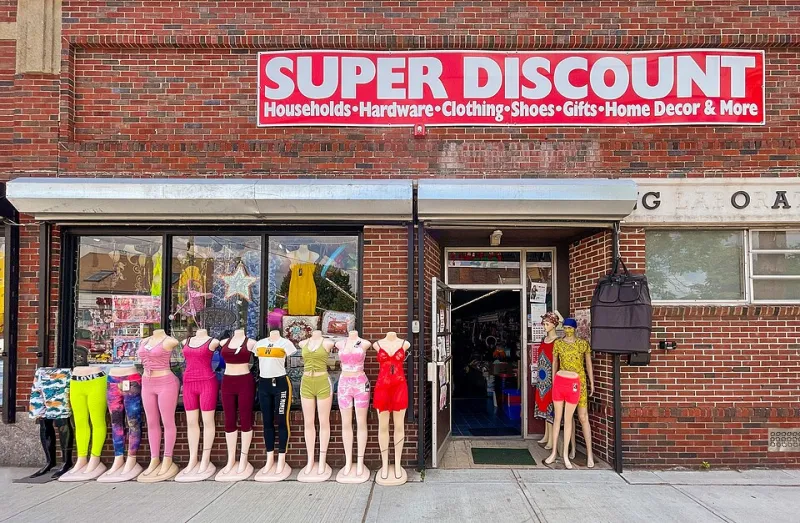
Photo: Kenneth C. Zirkel, CC BY-SA 4.0, via Wikimedia Commons
You walk into Target for paper towels. You leave with paper towels, a candle, two clearance sweaters, and a strong sense that you made great decisions. Somewhere between the entrance and the checkout line, numbers were weaponized against you — and they did their job beautifully.
This is the world of retail numerics, and it is far more sophisticated than a price tag that ends in .99. At 1280816 Hub, we're built on the idea that every number tells a story. In retail, those stories are written by marketing departments with very specific goals in mind. Here's how they do it.
The Charm of the Almost-Round Number
Let's start with the oldest trick in the book, because it still works embarrassingly well. Charm pricing — the practice of ending a price in .99 or .95 — has been documented in consumer research since the 1930s. A 2005 study published in Quantitative Marketing and Economics found that prices ending in 9 actually outsold lower prices in certain categories. Read that again. The more expensive item won.
The reason is simple and slightly unsettling: our brains process numbers from left to right, and we anchor on the first digit. $19.99 registers as "nineteen dollars and change" before the .99 even fully lands. $20.00 reads as twenty. That one penny difference encodes as a full dollar category shift in the mind.
"It's not rational, and consumers know it's not rational," says one retail marketing consultant who's worked with major grocery chains across the Midwest. "But knowing the trick doesn't make you immune to it. The cognitive shortcut runs faster than the logical override."
Big-ticket retailers have gotten even more nuanced. Luxury brands famously avoid charm pricing — a $4,000 watch is priced at $4,000, not $3,999.99. The round number signals confidence, quality, and a brand that doesn't need to hustle. The psychology works in both directions.
Scarcity Math: Why 'Limit 5' Makes You Want 6
Here's a number you've seen at Costco, CVS, and basically every Black Friday sale in existence: "Limit 3 per customer." Or 5. Or 2. The specific number almost doesn't matter — what matters is that there's a number at all.
Researchers at the University of Iowa studied this phenomenon and found that purchase limits dramatically increased how many units customers bought, even when the limit was set generously above what any normal shopper would want. A sign reading "Limit 12 per customer" on canned soup caused people to buy more cans than a sign with no limit at all.
The number activates scarcity logic. Your brain hears "limit" and immediately calculates: someone decided this was worth rationing. That reframes the product from an ordinary grocery item into something with social proof baked in. If they're limiting it, it must be worth having. The number is doing psychological heavy lifting that the product itself might not be able to do alone.
This is why flash sales work. Why "only 3 left in stock" on Amazon makes your cursor move faster. The scarcity isn't always real — but the number makes it feel real, and that's enough.
When the Number Becomes the Brand
Some of the most effective retail numerics aren't prices at all — they're product names. And once a number becomes cultural shorthand, it's essentially free advertising every time someone says it out loud.
Take 5-Hour Energy. The name does three things simultaneously: it tells you exactly what the product promises, it sets a specific expectation (five hours, not "a while"), and it sounds scientific without requiring any science. The number is the pitch. WD-40 works the same way — named after the 40th attempt at a water displacement formula, it sounds precise, tested, and trustworthy. Nobody asks what WD-1 through WD-39 were.
Then there's Heinz 57. The number wasn't even accurate when it was introduced — founder H.J. Heinz reportedly had more than 60 varieties at the time, but 57 felt right, sounded good, and stuck for over a century. The number was chosen for feel, not fact.
Marketing strategists call this "numeric anchoring in brand identity" — using a specific number to create a sense of precision, heritage, or authority that a descriptive word simply can't replicate. Numbers feel objective. They feel like evidence. And in a crowded aisle, feeling like evidence is worth a lot.
The Bundle Trap and the Power of Three
Walk through any pharmacy and you'll see it everywhere: buy 2, get 1 free. Not buy 3 for the price of 2. The framing matters enormously.
"Buy 2, get 1 free" triggers a gain mindset — you're receiving something. "3 for the price of 2" triggers a math problem. Retailers know that gain framing outperforms discount framing in most consumer categories, and the number three has a particular psychological resonance. Three feels complete. Two feels like you stopped short. Four feels like excess.
This is why value meals come in sizes small, medium, and large — and why "medium" is the one most people order. It's positioned as the rational middle, the Goldilocks number. Fast food chains have spent decades refining the numeric architecture of their menus to nudge customers toward specific items. The numbers you see aren't neutral. They're designed.
Seeing the Playbook
None of this means you're helpless. Awareness is genuinely useful here — studies do show that consumers who understand charm pricing are somewhat less susceptible to it, even if they can't fully escape the effect. Knowing that a purchase limit is often a marketing tool rather than a real constraint can slow down that impulse buy.
But the deeper takeaway is something 1280816 Hub is kind of built around: numbers are never just numbers. They carry intent, history, and design. The $19.99 on a shelf, the "5 remaining" on a product page, the name on a bottle of energy drink — each one is a story being told to you, carefully, with a specific ending in mind.
The question is whether you're reading the story, or whether the story is reading you.