Say 'The' Before Your Freeway and Everyone Knows Exactly Where You're From
Two Letters That Give You Away Instantly
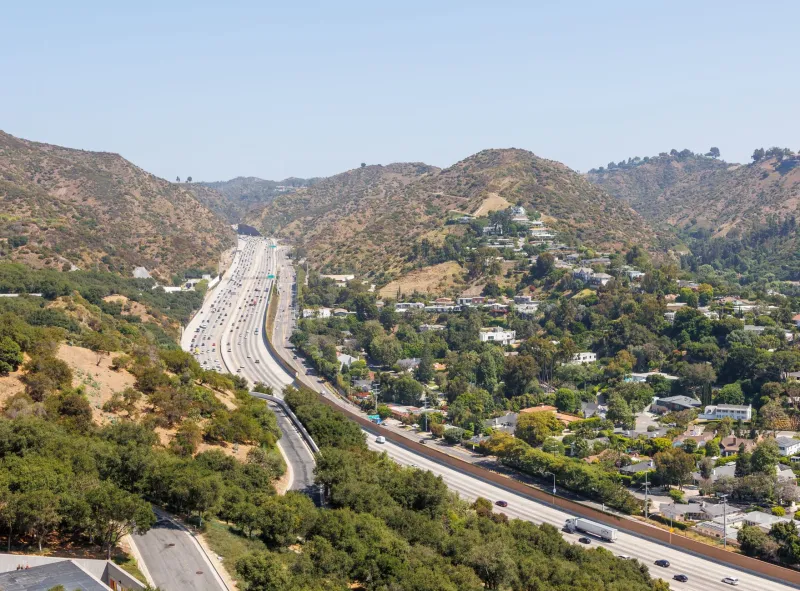
You can spot a Southern Californian in a conversation within seconds, and it has nothing to do with tan lines or a surfer drawl. It's the article. Ask a transplant how they're getting across town and they'll say they're taking I-405. Ask a native and they'll tell you they're hopping on the 405, cutting over to the 101, maybe braving the 110 at rush hour if they're feeling brave.
That little word — the — is doing a lot of quiet work. It's a shibboleth, a dialect marker, a tiny piece of grammar that maps almost perfectly onto a region. Say "the 5" in Atlanta or Chicago and you've outed yourself before you've finished the sentence.
So how did a definite article become a regional accent for road signs? The answer involves old-fashioned naming habits, a bit of civic vanity, and the fact that Southern California got its freeway system earlier and more personally than most of the country.
When Roads Had Names, Not Numbers
Here's the key to the whole mystery: the earliest major highways in the Los Angeles area weren't introduced to the public as numbers at all. They had names. The Arroyo Seco Parkway, opened in 1940 and now part of the 110, was a destination in its own right. Later came the Hollywood Freeway, the Harbor Freeway, the Santa Ana Freeway, the San Diego Freeway.
And people talked about them the way you'd talk about any named thing. You don't say you're taking "Hollywood" — you say you're taking the Hollywood Freeway. The article came free with the name.
When the state started layering route numbers on top of those names, Angelenos kept their grammar and just swapped in the digits. The Hollywood Freeway became the 101. The San Diego Freeway became the 405. The definite article stuck around like an old nickname that outlives the real name.
Elsewhere in the country, the interstate system arrived in the 1950s as just that — a system. Cold, uniform, federal. Interstate 95. Interstate 80. Nobody in New Jersey ever gave I-95 a nickname they loved enough to grammatically adopt. The roads were infrastructure, not landmarks, so the article never took hold.
The Rest of the Country Isn't Wrong, Just Different
It's worth saying plainly: neither dialect is "correct." Style guides and transportation departments are perfectly happy with a bare "I-405" or a bare "405." The article is pure habit, not grammar law.
But habits this durable usually mean something. Linguists point out that people grammatically mark the things they think of as specific, known places rather than abstract routes. "The 405" implies there is exactly one, you know which one, and you both suffer on it regularly. It's the same instinct that has New Yorkers riding "the A train" — another transit system where lines feel like places.
The pattern holds surprisingly well across Southern California. San Diegans say "the 5." Folks in the Inland Empire say "the 10" or "the 60." Head north to the Bay Area and the article starts falling away — you take 101 or I-80 up there, no "the" required. The dividing line is roughly where the freeway-naming era's cultural grip loosened.
A Number Is Just a Number Until It's a Place
There's something a little poetic about it, honestly. A highway number is about as impersonal as information gets — three digits assigned by a bureaucracy. But lived experience has a way of warming things up. Once a road has cost you a few hundred hours of your life in traffic, it stops being a route and starts being a character in your biography.
And that's really what the article signals: intimacy. Angelenos don't say "the 405" because of a rule. They say it because the 405 is a known adversary, a shared experience, a specific thing everyone in the room has sat on in bumper-to-bumper silence. The grammar encodes the relationship.
So the next time someone drops a "the" before a highway number, don't correct them. Just do the math. You now know roughly where they learned to drive — and probably how much time they've lost to the Sepulveda Pass.