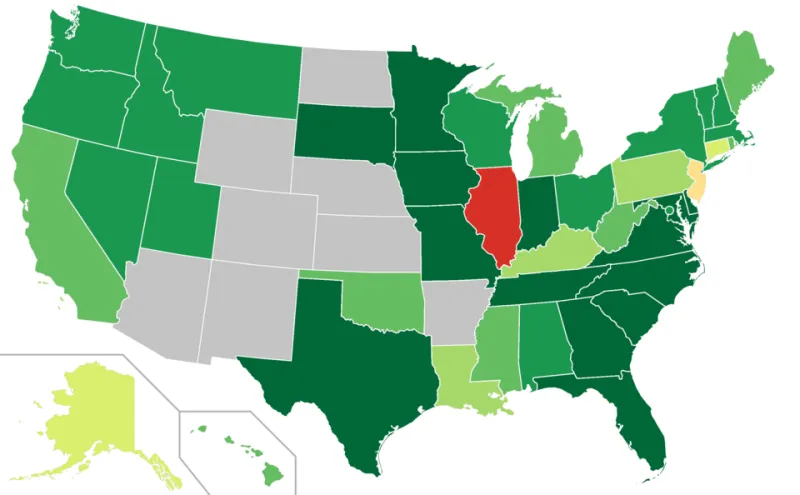
Stuck at 7.25: The Frozen Number That's Quietly Shaping Millions of American Lives
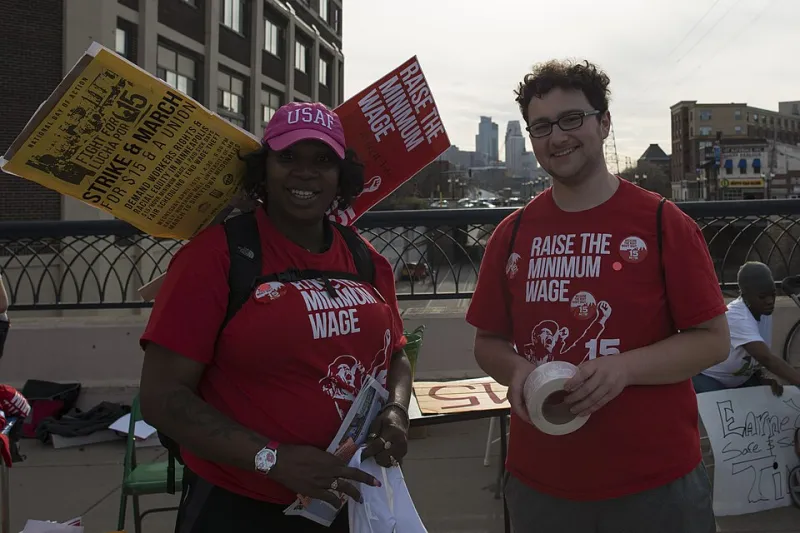
Photo: Fibonacci Blue, CC BY 2.0, via Wikimedia Commons
Some numbers carry weight. Some numbers carry history. And then there's $7.25 — a figure so politically loaded that Congress hasn't touched it in over fifteen years, even as everything from a gallon of milk to a Netflix subscription has quietly climbed past it.
The federal minimum wage hasn't budged since July 24, 2009. That's not a typo. That's not a rounding error. That's just the reality for roughly 1.1 million American workers who still earn at or below that threshold, according to Bureau of Labor Statistics data. And for a country that loves to debate just about everything, this one specific number has somehow managed to stay frozen in amber while the rest of the economy kept moving.
So what's the deal? Why is $7.25 so untouchable — and what does it actually mean for the people living closest to it?
When 7.25 Was Considered Progress
To understand where we are, you have to rewind. The Fair Minimum Wage Act of 2007 was supposed to be a win. It raised the federal floor in three steps — from $5.15 to $5.85, then $6.55, then finally $7.25 in 2009. At the time, advocates called it overdue relief. Opponents called it a job killer. Sound familiar?
The thing is, $7.25 in 2009 dollars isn't the same as $7.25 today. Adjusted for inflation, that wage has actually lost purchasing power over the past decade and a half. The Economic Policy Institute estimates that a worker earning the federal minimum today has less real buying power than a minimum wage worker did in the late 1960s. Numbers don't lie — but they can sure be misleading when you stop updating them.
The Political Stalemate, Explained
Here's where it gets complicated. Congress hasn't been able to agree on a raise because the minimum wage debate has become less about economics and more about identity. For many conservatives, raising the federal floor represents government overreach into the free market. For progressives, leaving it at $7.25 is a moral failure. Neither side is budging, and the number just... sits there.
The last serious push came in 2021, when Democrats tried to tuck a $15 federal minimum into the American Rescue Plan. The Senate parliamentarian ruled it out of order under budget reconciliation rules, and that was that. Since then, the issue has mostly collected dust in committee.
State governments, tired of waiting, have largely gone their own way. As of 2024, more than 30 states have set their own minimums above the federal rate. California sits at $16. Washington State is at $16.28. Florida voters approved a path to $15 back in 2020. Meanwhile, states like Georgia and Wyoming technically still default to the federal $7.25 — meaning that number actually matters in ways it doesn't elsewhere.
The People Behind the Number
Talk to workers in states that still rely on the federal baseline, and you start to understand what $7.25 really looks like in practice. It's a full-time schedule that still qualifies you for food assistance. It's doing the math on whether you can afford a flat tire. It's a second job not because you want one, but because one paycheck at that rate simply doesn't cover rent.
Small business owners have their own complicated relationship with the number. A diner owner in rural Mississippi might genuinely fear that a mandated $15 wage would force her to cut hours or close entirely. A restaurant group operating in Seattle — where the minimum is already well above $15 — has largely adapted and is still operating. The economic research on job losses from minimum wage increases is genuinely mixed, which is part of why the debate never fully resolves.
Economists themselves are divided. Traditional models predicted significant job losses from large wage hikes. More recent studies, including influential work from economists at UC Berkeley, have found that moderate increases have minimal employment effects. The honest answer is: it depends on the local economy, the size of the increase, and how quickly it's phased in. But "it depends" doesn't make for great campaign slogans.
What a Number Tells Us About Ourselves
At 1280816 Hub, we're kind of obsessed with what numbers reveal — not just what they measure, but what they mean. And $7.25 is one of the most revealing numbers in American public life right now.
It tells us that federal policymaking can get so gridlocked that even widely popular ideas (polls consistently show broad public support for a higher minimum wage) can't make it through the legislative process. It tells us that the gap between what Americans say they want and what their representatives actually do is sometimes enormous. And it tells us that when the federal government fails to act, states and cities fill the vacuum — for better or worse, depending on where you happen to live.
The result is a patchwork country where your hourly wage floor can vary by $10 or more depending on which side of a state line you're standing on. That's not a system anyone designed intentionally. It's what happens when a single number gets too politically hot to touch.
Is Change Actually Coming?
Maybe. The Raise the Wage Act has been introduced in multiple congressional sessions, calling for a gradual increase to $17. It hasn't passed. The political math in the Senate — specifically the 60-vote threshold needed to overcome a filibuster — makes any standalone wage bill an uphill climb regardless of which party holds the majority.
What's more likely, in the near term, is continued state-level action. More states will probably raise their own floors, further isolating the federal $7.25 as a number that matters mostly to workers in a handful of lower-wage states — which, not coincidentally, tend to have lower costs of living but also lower average wages overall.
The irony is that the longer $7.25 sits unchanged, the less relevant it becomes in most of the country — and paradoxically, the easier it is to ignore at the federal level. It becomes a ghost number: technically on the books, functionally irrelevant in much of the country, but still very real for the workers it directly affects.
The Story This Number Is Still Writing
Every number tells a story, and $7.25 is still mid-chapter. It's a story about what happens when political systems can't keep pace with economic reality. It's about the workers who built careers around it and the employers who structured their businesses around it. It's about a country that can't quite agree on what a fair day's wage looks like — or who gets to decide.
What's clear is that the number itself has become almost symbolic at this point. Whether you think $7.25 is a floor that needs raising or a policy that should be left to the states, the fact that it hasn't changed in over fifteen years says something loud about how Washington works — or doesn't.
Some numbers age gracefully. This one is just aging.