Three Digits, Total Control: The Secret Life of Your Credit Score
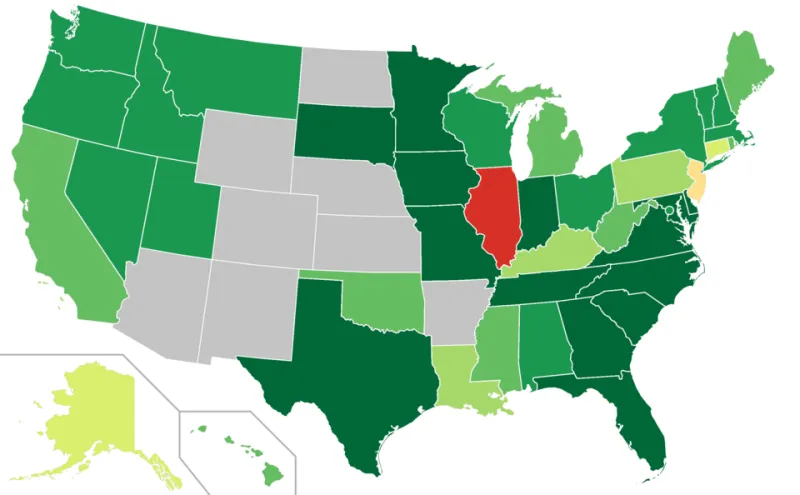
Photo: Szmenderowiecki, CC BY-SA 4.0, via Wikimedia Commons
Here at 1280816 Hub, we're obsessed with what numbers do to people — not just what they represent. And few numbers do more heavy lifting in an American's life than the three-digit credit score sitting in a database somewhere with your name on it. You might not think about it every day, but it's thinking about you.
Right now, that number is either opening doors or quietly closing them. And the wild part? Most people don't fully understand how it's calculated.
The Formula Nobody Fully Explains
The FICO score — the dominant model used by the vast majority of U.S. lenders — runs on a weighted formula that feels almost deliberately opaque. The broad strokes are public knowledge: payment history accounts for about 35% of your score, amounts owed comes in at 30%, length of credit history sits at 15%, new credit at 10%, and credit mix at the final 10%. Simple enough, right?
Except it isn't. Within each of those categories are dozens of micro-variables that interact in ways even financial professionals sometimes struggle to predict. A single 30-day late payment can crater a score by 100 points or more, depending on how strong it was to begin with. Closing an old credit card — something that intuitively feels responsible — can actually hurt you by shrinking your available credit and shortening your average account age at the same time.
The number isn't just math. It's behavioral modeling dressed up as math.
When a Few Points Change Everything
Let's talk about what a score gap actually costs you in the real world, because the stakes are genuinely staggering.
Say you're buying a $350,000 home. With a credit score in the 760–850 range, you might lock in a 30-year mortgage at around 6.5% interest. Drop that score to the 620–639 range, and that same loan could come with a rate closer to 8% or higher. Over 30 years, that gap translates to tens of thousands of dollars paid in additional interest — sometimes more than $100,000 on a mid-range home purchase.
And it doesn't stop at mortgages. Auto loans, personal lines of credit, credit card APRs — every single one of these financial products is priced, in part, based on that three-digit number. People with lower scores don't just pay more. They sometimes don't get access at all.
Then there's the employment angle, which surprises a lot of people. Certain industries — finance, government contracting, even some retail management positions — run credit checks as part of the hiring process. A rough patch that dinged your score a few years back could follow you into a job interview. The number that started as a lending tool has quietly expanded its jurisdiction.
The Ghost in the Machine
One of the stranger realities of the credit score system is how invisible it operates. Errors in credit reports are more common than most people assume. A Federal Trade Commission study found that roughly one in five Americans had a verifiable error on at least one of their three major credit reports. Some of those errors were minor. Others were significant enough to meaningfully suppress someone's score.
The three major bureaus — Equifax, Experian, and TransUnion — each maintain their own separate data, which means your score can actually vary between them. Lenders choose which bureau to pull from, and that choice can affect whether you qualify for a product or what rate you receive. You're not just one number. You're three slightly different versions of a number, and you rarely know which one is being used.
It's a system built on data, but the data isn't always clean.
Taking Back Some Control
Here's where the story gets a little less frustrating. Because while the algorithm is complex, the levers available to everyday Americans are actually pretty straightforward — they just require consistency.
Paying on time, every time, is the single most impactful habit you can build. It sounds obvious, but automating minimum payments on every account eliminates the human error factor entirely. Beyond that, keeping your credit utilization — the ratio of your balance to your credit limit — below 30% (and ideally closer to 10%) can move the needle faster than almost anything else.
One underused strategy: becoming an authorized user on a family member's long-standing, well-managed account. You inherit some of the account's positive history without needing to take on any debt yourself. It's one of the few genuine shortcuts the system allows.
And if you haven't pulled your free credit reports recently, AnnualCreditReport.com is the official source — mandated by federal law to provide free access to all three bureaus. Reading through them line by line, looking for accounts you don't recognize or balances that seem off, is time well spent.
The Number Is Not the Whole Story
At 1280816 Hub, we believe every number tells a story — but we also believe numbers can be misleading narrators. A credit score is a snapshot, not a biography. It captures a moment in time, filtered through a formula that was designed to predict risk for lenders, not to reflect your actual character or potential.
Millions of Americans are working their way back from medical debt, divorce, job loss, or the financial wreckage of the pandemic years. Their scores might not reflect who they are today. The system is getting better — newer scoring models are starting to factor in things like on-time rent and utility payments — but change in this space moves slowly.
What you can do, starting right now, is stop treating your credit score like a mystery. It's a number. Numbers can be understood, and once understood, they can be worked with. Three digits don't have to run your life forever — but they will keep running it if you let them stay invisible.